
Benefits of Mobile Training Mirrors: 7 Ways They Improve Performance
Table of Contents
What Are Mobile Training Mirrors and How Do They Differ From Fixed Smart Mirrors?
Portable Mirrors vs Fixed Smart Mirrors: A Side-by-Side Look
What Portability Actually Means in Practice
Where Each Format Fits
Instant Visual Feedback for Technique Correction
How Real-Time Feedback Speeds Up Skill Acquisition
Reducing Injury Risk Through Better Posture and Alignment
Portable Dance Mirrors on Wheels: Professional Results Without Permanent Installation
Storage, Setup and Durability for Multi-Use Venues
Safety Standards for Gym Mirrors: What to Check Before You Buy
Group Training, Coaching and Accessibility: Where Mobile Mirrors Win
For Coaches and Teams
For Schools and Performing Arts
For Clinics and Rehabilitation
Accessibility and Different Fitness Levels
The Shared-Space Advantage
Privacy, Camera Use and Data Security in Portable Mirror Systems
Costs, Subscriptions and Comparing Mobile Mirrors With Alternatives
Frequently Asked Questions
Last Updated: October 21, 2026
What Are Mobile Training Mirrors and How Do They Differ From Fixed Smart Mirrors?
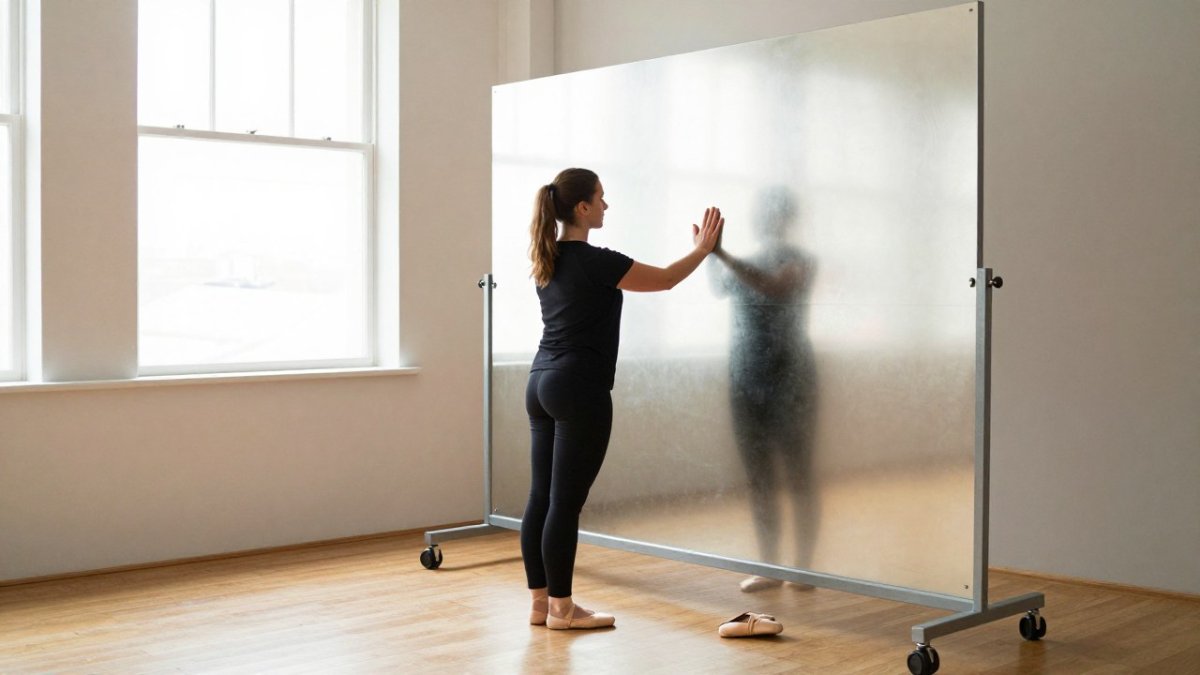
Mobile training mirrors are freestanding, wheel-mounted reflective panels that bring a full mirrored wall into any space without drilling a hole.
A fixed smart mirror is bolted to one room, usually with a subscription attached. Mirrors for Training has made British-built portable mirrors on wheels since 2007, and the questions we hear most are about rent, storage and safety, not screen size.
You get instant visual feedback, the flexibility of a temporary installation, and no landlord negotiations. Below: seven ways they improve performance, plus what to check before you buy.
Portable Mirrors vs Fixed Smart Mirrors: A Side-by-Side Look
The two formats solve different problems. Fixed smart mirrors suit a single dedicated room with reliable power and a subscription budget. Portable mirrors suit multi-use venues, rented spaces and any room that has to become something else at 6pm.
Feature | Portable Training Mirror | Fixed Smart Mirror |
Installation | Freestanding, no wall fixing | Permanent wall mount and wiring |
Power needs | None | Mains power required |
Cost model | One-off purchase | Hardware plus subscription |
Portability | Rolls and stacks for storage | Fixed to one room |
Best for | Multi-use venues, rented studios | Dedicated single-purpose rooms |
Camera and data | None, so no data collection | Built-in camera and app |
Setup time | Minutes, no tools | Hours to days, trades required |
Storage footprint | Stacks flat against a wall or in a cupboard | Occupies wall space permanently |
Durability focus | Safety-backed glass and lockable castors | Screen and electronics lifespan |
Reconfiguration | One person can reposition a full run | Requires remounting and rewiring |
Don't assume the smart option is always the upgrade. In a hired hall hosting dance on Monday and youth sports on Wednesday, a permanent installation is often impossible, portability is the only workable answer.
What Portability Actually Means in Practice
Portability is a chain running from castors to frame to glass, and a weak link anywhere makes the unit awkward to live with.
Castors: Lockable swivel castors are the minimum. A mirror that rolls freely is a hazard; one that locks firmly behaves like a fixed panel. Check the locking mechanism holds under sideways pressure, not just forward motion.
Setup time: A well-designed portable mirror goes from stored to in-use in minutes, with no tools and no second pair of hands, vital where a dance class finishes at 7pm and a meeting starts at 7:30pm.
Storage: Stackable or fold-flat designs let a run of mirrors occupy a fraction of the floor area of a fixed wall.
The thing nobody tells you about portable mirrors is that the wheels matter as much as the glass. Cheap castors seize, wobble, or fail to lock, and a mirror that drifts mid-class is a hazard. Check the locking mechanism before anything else.
Where Each Format Fits
Fixed smart mirrors suit a dedicated studio with reliable power and a subscription budget. Portable training mirrors suit rooms that change use, walls that belong to someone else, or equipment that travels. The question isn't which technology is better, but which fits the room you actually have.
Instant Visual Feedback for Technique Correction
Visual feedback closes the gap between what a movement feels like and what it looks like. Seeing your alignment in real time lets you correct it in the moment instead of waiting for a coach's notes after the rep.
Research indexed by PubMed Central on mirror training and motor performance describes mirror-based training as a technique that can improve the range, velocity and accuracy of limb and joint movement.
How Real-Time Feedback Speeds Up Skill Acquisition
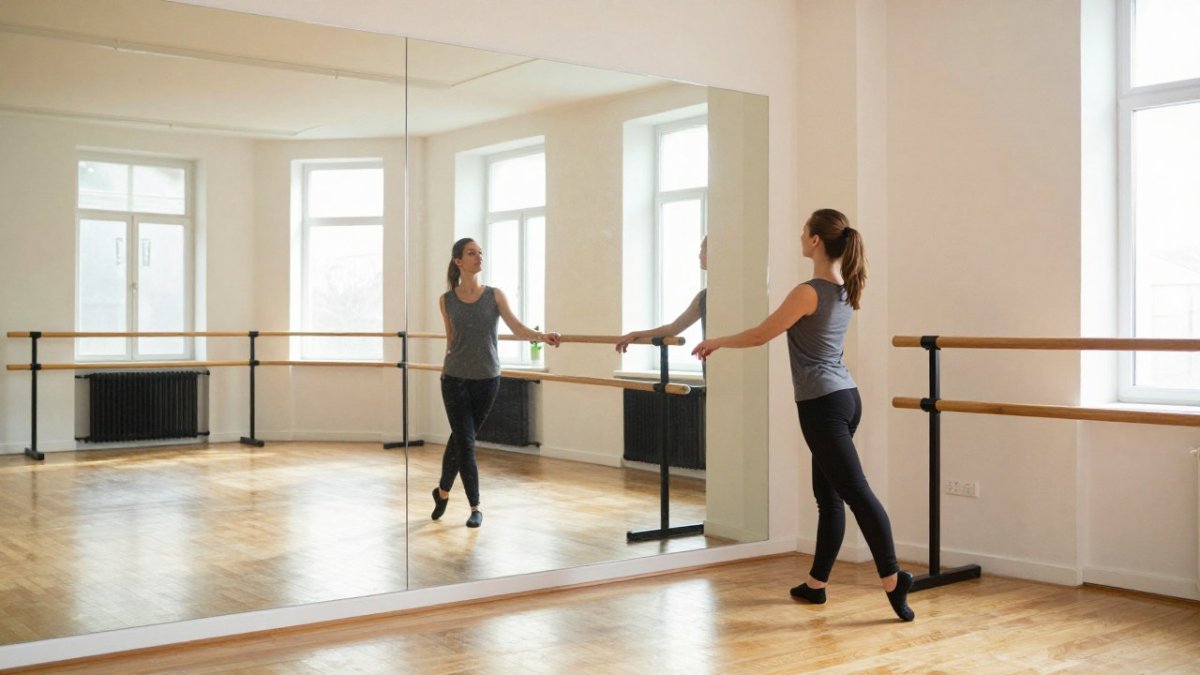
A dancer who watches their hip position adjusts within the same eight-count. A boxer who sees their guard drop fixes it before the next round. This is why portable dance mirrors on wheels earn their place in teaching studios: immediate correction turns a repeated error into a corrected habit.
Pro Tip Position the mirror at a slight angle rather than dead-on. A three-quarter view shows both the front and side of a movement at once, which catches the faults a straight-on reflection hides, particularly shoulder rotation and hip shift.
Reducing Injury Risk Through Better Posture and Alignment
Poor alignment quietly causes training injuries.
In strength training it self-checks spinal position during squats and deadlifts; in yoga and Pilates, level hips and stacked shoulders; in rehabilitation, it lets a patient see the movement they're asked to reproduce.
A useful rule we share with clinic managers: watch for the fault that appears when the client is tired, not fresh.
Portable Dance Mirrors on Wheels: Professional Results Without Permanent Installation
Rented studios are the most common reason dance schools come to us. A landlord who won't permit wall fixings is protecting the building.

The stability question comes up every time, and it's the right one. Lockable wheels are the answer: once locked, the mirror behaves like a fixed panel.
Storage, Setup and Durability for Multi-Use Venues
Stackable design makes the maths work in a small space. Mirrors that fold flat against each other take a fraction of the floor area of a fixed wall, so a studio tight on storage can still offer a mirrored environment. Maximizing this versatility allows even the most compact workout area to function as a fully equipped minimalist home gym while maintaining an open and uncluttered aesthetic.
Setup time: minutes, not hours, with no tools required
Storage: stack against a wall or in a cupboard between sessions
Durability: safety-backed glass holds together if struck, which matters in high-traffic halls
Safety Standards for Gym Mirrors: What to Check Before You Buy
Safety standards for gym mirrors come down to the glass, the frame and the fixings. Safety-backed glass holds its fragments in place if it breaks rather than shattering across the floor, not optional in a room full of people moving at speed.
For permanent installations, the relevant guidance sits with the Health and Safety Executive on workplace safety, which sets out the general duty to manage risks in premises used by staff and the public. For portable equipment, the practical checks are simpler:
Confirm the glass is safety-backed, not standard mirror
Test that every castor locks firmly and holds under sideways pressure
Check the frame has no sharp edges at hand height
Watch Out Skipping the lock test is the most common and most expensive mistake. A mirror that rolls when a client grabs it for balance can cause a fall, and in a clinic or school setting that is a serious incident, not an inconvenience.
Group Training, Coaching and Accessibility: Where Mobile Mirrors Win
Group sessions are where portable mirrors outperform almost everything else. A single run lets twelve people check their own form at once, which no coach can do verbally. The loop, demonstrate, observe, correct, is the core of group teaching, and mirrors multiply the coach's attention without adding staff.
For Coaches and Teams
A sprint coach can position mirrors to show knee drive and arm action from the side, then move them for the next drill. A strength coach can angle a run so lifters see spinal position during squats without turning their heads. A boxing coach can let a whole class check guard height and footwork at once. The practical advantage is reconfiguration: a fixed wall shows one angle from one position, while portable mirrors can form a line, a corner or an L-shape depending on the drill, and move between pitches, courts or halls.
For Schools and Performing Arts
For schools and performing arts departments, the same mirrors serve dance, drama and PE without a dedicated studio.
Safeguarding matters here. A conventional portable training mirror contains no camera and no recording capability, so there is no footage of pupils to store, review or protect, an advantage where capturing images of children brings obligations easiest met by not capturing them at all.
For Clinics and Rehabilitation
In clinics, portable mirrors let a therapist position the reflection at the height and angle that suits the patient, then move it aside for the next appointment. A patient learning to reproduce a movement can watch themselves between sessions, supporting body awareness and carry-over into daily life.
Accessibility and Different Fitness Levels
Accessibility is the quieter benefit. Mirrors can be positioned at the height and angle that suits a seated participant, a wheelchair user, or someone recovering from injury, a fixed wall mirror can't be adjusted to the person. That adjustability extends to fitness levels: beginners need a clearer side or three-quarter view to reproduce a movement, while experienced participants can check finer details, shoulder rotation, hip shift, ankle tracking, that are hard to feel but easy to see.
Pro Tip When setting up for a mixed-ability group, place one mirror at a three-quarter angle for the front row and a straight-on run for the back. That gives beginners a clearer side view and experienced participants a direct check, without moving equipment mid-session.
The Shared-Space Advantage
Across coaches, schools, clinics and mixed-ability classes, the space is shared and the equipment has to adapt. Fixed mirrors assume one room, one purpose and one audience. Portable mirrors assume the room will be something else tomorrow, and are built to be moved, stored and reconfigured without trades, fixings or permission, exactly where mobile training mirrors win.
Privacy, Camera Use and Data Security in Portable Mirror Systems
Privacy is where portable mirrors have a clear advantage. A conventional portable training mirror contains no camera, no microphone and no internet connection: nothing to record, store or breach.
That matters in clinics working with vulnerable adults, in schools with safeguarding obligations, and in any setting where footage of a client's movement would be sensitive. The Information Commissioner's Office guidance on data protection sets out obligations that apply the moment you capture identifiable images, and the simplest way to meet them is not to capture them at all.
If you do choose a camera-equipped system, ask three questions before signing: where is the footage stored, how long is it retained, and who can access it. A supplier who can't answer clearly isn't ready for a clinical or educational setting.
Costs, Subscriptions and Comparing Mobile Mirrors With Alternatives
The cost comparison is more lopsided than most buyers expect, because subscriptions hide in the smart-mirror model. A fixed smart mirror carries hardware cost plus an ongoing monthly fee.
Our own range illustrates the spread. A single Rehabilitation and Posture Mirror is £495, a Tri Fold Mirror is £695, and a set of four portable mirrors on wheels is £2,200. Larger installations scale from there, with a set of ten portable mirrors at £4,800 for a full studio wall.
Compare that with a fixed installation: wall fixings, making good, landlord consent, and a subscription on top. For a rented venue, the portable route usually wins on first-year cost alone. For a permanent, single-purpose studio with power and budget to spare, a fixed system can still make sense.
Key Takeaway Buy for the room you actually have, not the room you'd like. If the space changes use during the day, or you don't own the walls, portability isn't a downgrade. It's the only specification that fits.
Frequently Asked Questions
Why are mobile training mirrors better than wall-mounted mirrors for multi-use spaces?
Mobile training mirrors offer flexibility that fixed wall mirrors cannot. In a multi-use venue, you can wheel them into position for a dance class, then move them aside for a fitness boot camp or youth sports session. They require no drilling or permanent installation, which matters if you rent your space or have a landlord who restricts structural changes. Portable mirrors on lockable wheels also let you reconfigure a room quickly, and they stack or store compactly when not in use. For facility managers juggling different activities in one hall, that adaptability is the main benefit.
Are mobile training mirrors safe for high-intensity fitness environments?
Safety depends on the build quality and the features you choose. Look for lockable wheels that keep the mirror stable during vigorous movement, safety-backed glass that holds together if struck, and a weighted base to prevent tipping. In high-intensity sessions, participants may lean on or brush against the mirror, so a sturdy frame and secure locking mechanism are essential.
How do portable mirrors improve technique correction in dance?
Portable dance mirrors on wheels give dancers immediate visual feedback on alignment, posture and movement. A dancer can see whether a hip is level, a shoulder is dropped or a line is clean, and correct it in real time rather than waiting for a teacher's note. Research on mirror training suggests it can improve range, velocity and accuracy of movement, particularly when used consistently. For dance schools, having professional-grade mirrors that can be positioned exactly where needed, without permanent installation, makes that feedback accessible in any studio space.
What features should I look for in professional-grade mobile training mirrors?
Prioritise lockable wheels for stability, safety-backed glass, a rigid frame and a stackable or compact storage design. Check the mirror dimensions suit your space and the number of users, and confirm the mirrors are suitable for the activities you run, from strength training to yoga or boxing. Ask about durability under frequent movement, and whether replacement glass is available if a mirror is damaged. For clinics and rehab settings, consider a rehabilitation or posture mirror designed for movement assessment.
The hardest part of choosing training mirrors isn't the glass or the price. It's being honest about how the room gets used on a Tuesday afternoon versus a Saturday morning. If your space has to change shape, Mirrors for Training builds British-made portable mirrors on wheels with lockable castors for stability and a stackable design that stores against a wall. Browse the range and set up a professional mirrored environment that adapts to your venue rather than the other way round.
SHOP NOW

Comments