
How Do You Choose Shatterproof Wall Mirrors?
Last Updated: November 24, 2026
Quick Summary
To choose shatterproof wall mirrors, weigh the material, the safety backing, and how the mirror will be mounted and moved. Shatterproof is a marketing term, not a formal standard, so it reduces breakage risk and fragment sharpness rather than eliminating breakage.
Shatterproof is a marketing term rather than a formal standard, so check the safety backing.
Acrylic mirrors weigh roughly half as much as glass but scratch more easily.
Leave at least 100 mm between the mirror edge and any adjoining wall or door frame.
Keep the bottom edge at least 300 mm above the floor in rooms used by children.
Cover no more than about two-thirds of the usable wall width with the mirror.
Which mirror fits your room?
Mirrors for Training supplies British-made, safety-backed portable mirrors for studios, gyms and clinics.
Table of Contents
How Do You Choose Shatterproof Wall Mirrors?
Choosing shatterproof wall mirrors comes down to three things: the material, the safety backing, and how the mirror will be mounted and moved. Mirrors for Training builds portable, safety-backed mirrors on lockable wheels. Our advice starts with understanding what "shatterproof" actually promises, because the term is used loosely across the market.
Facility managers at multi-use gyms, dance school principals, and rehabilitation clinic managers often face the same problem. They need a mirror that is safe around children, tolerant of knocks, and suitable for a shared room that changes use several times a day. The right choice depends less on the label and more on the specific risks in your space.
What Shatterproof Actually Means for a Wall Mirror
Shatterproof is a marketing term rather than a formal standard, so read it carefully. A mirror described this way is usually built to reduce the risk of breakage and to limit how sharp fragments become if it does break. It does not mean the mirror cannot break.
Tempered glass and safety-backed glass both lower breakage risk. A safety backing film holds fragments together when glass cracks. Acrylic and other plastic mirrors avoid glass entirely, which removes the shard risk but introduces a different trade-off around scratching.
Watch out: Do not assume a mirror is safe just because the product page uses the word shatterproof. Ask the supplier what the safety backing is and whether it is designed for the impact level of your room.
Acrylic Mirror Versus Glass Mirror: Which Suits Your Space
For most multi-use rooms the real decision is between an acrylic mirror and a safety-backed glass mirror. Both can be sold as shatterproof, but they behave very differently in use. The table below sets out the trade-offs that matter most when you are specifying a mirror for a gym, studio, clinic or hall.
Property | Acrylic mirror | Safety-backed glass mirror |
Image clarity | Good, but a slight distortion is common at the edges and across large panels | Sharp, accurate reflection with minimal distortion |
Scratch resistance | Low: dust, rings and abrasive cloths mark the surface | High: glass resists everyday scuffs |
Weight | Roughly half the weight of glass for the same panel size | Heavy: needs stronger fixings and often two installers |
Typical cost | Lower material cost, but replacement is more frequent in high-contact rooms | Higher upfront cost, longer service life |
Failure behaviour | Cracks or crazes rather than shattering into shards | Cracks but is held together by the backing film |
Cleaning | Mild plastic-safe cleaner only; ammonia clouds the surface | Standard glass cleaner is fine |
Best use | Rooms with children, vulnerable adults, frequent knocks or regular relocation | Rooms where reflection accuracy matters and impact risk is low |
The trade-off is surface durability: acrylic scratches more easily, and a scratched panel distorts the reflection permanently. In a room where equipment is dragged past the mirror, expect to replace acrylic panels more often than glass.
Watch out: Do not compare prices on panel size alone. Ask the supplier for the expected service life in your type of room.
Best for: Acrylic suits mixed-use rooms, rehabilitation spaces and anywhere the mirror will be moved often. Skip if: You need the sharpest possible reflection for detailed technique review in a room with little impact risk.
Choosing Unbreakable Mirrors for Gyms and Busy Halls
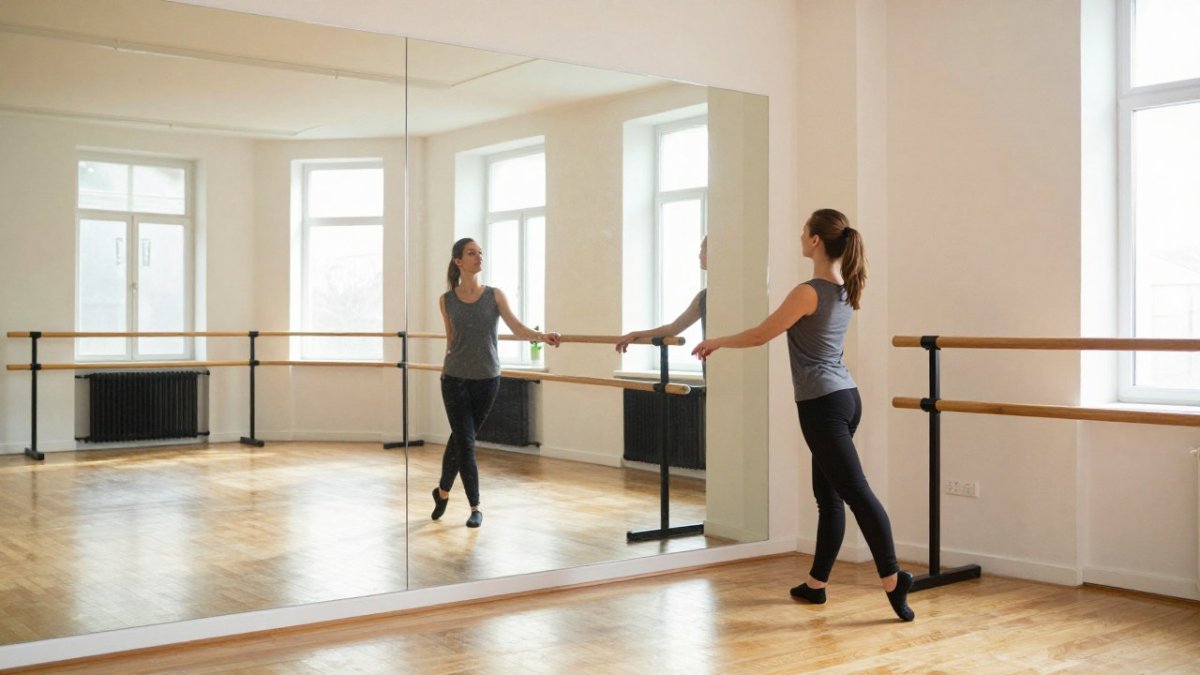
Gyms and busy halls place the heaviest demands on a mirror. Equipment gets dropped, bags get swung, and people lean against wall panels between sets. Choose a mirror rated for repeated contact, and check that the frame and fixings can take that load. You can compare a ready installed set of four wall mirrors with installation that is built for gym use.

For a deeper look at multi-use installation trade-offs, see our practical guide to choosing mirrors for multi-use venues.
Measuring Your Wall and Selecting Size, Shape and Frame
Measure the wall before you choose a size, and write the numbers down. A mirror that looks right in a showroom can overwhelm a small studio or leave gaps in a large hall. The method below works for fixed and portable mirrors alike.
Step 1: Measure the usable wall. Run a tape measure along the full width at skirting level and again at eye height, because walls are rarely perfectly straight. Note the floor-to-ceiling height in the centre and at both ends. Record any fixed obstacles: light switches, sockets, radiators, doors, fire equipment and alarm points.
Step 2: Set the clear margin. Leave at least 100 mm between the mirror edge and any adjoining wall, door frame or radiator so the panel does not sit tight against a surface that can transfer knocks or heat. In a room used by children, keep the bottom edge at least 300 mm above the floor to reduce accidental contact.
Step 3: Apply a sizing rule. A common pattern is to cover no more than about two-thirds of the usable wall width, which leaves visual breathing space and room for fixings. For a wall 4 m wide, that suggests a mirror up to roughly 2.6 m wide. For full-length movement work, the mirror should run from about 300 mm above the floor to at least 1.8 m high so most adults can see their whole body.
Step 4: Choose the shape. Rectangular mirrors suit wide walls and most training uses because they tile cleanly and waste little wall space. Full-length mirrors suit dance and movement assessment where you need to see the whole body. Circular and arched mirrors work in reception areas and smaller rooms but cover less usable reflective area for the same wall width.
Step 5: Match the frame to the job. Frame finish, whether black, gold or chrome, mainly affects appearance, but a sturdy aluminium alloy frame also adds rigidity and protects the panel edges. For a portable unit, the frame carries the load every time the mirror is moved, so check the joint construction rather than the colour.
Worked examples. A 3 m wide studio wall with a door at one end leaves about 2.4 m of usable width; applying the two-thirds rule gives a mirror up to about 1.6 m wide. A 6 m hall wall with no obstacles can take a 4 m run of panels, split into two or three sections for easier handling. A small clinic room of 2.5 m width is better served by a single 1.2 m panel than by full wall coverage.
Watch out: Do not order a mirror to the exact wall width. Skirting boards, uneven plaster and door frames reduce the true usable width, and a panel cut to the full measurement often will not fit once it arrives.
Portable Mirrors on Wheels Versus Wall Fixings
Portable mirrors on wheels avoid drilling into walls, which matters when you rent your space or cannot alter it. Lockable wheels keep the unit stable during use, and stackable designs save storage space when the room is not in use.
Wall fixings give a more permanent, flush finish and are better for a room used only for one purpose. If you need a fixed installation, our wall-mounted barre kit shows the type of fixed option to compare against a mobile setup.
Before you commit, check how the mirror will be stored, how many people will move it, and whether the floor surface allows the wheels to roll smoothly.
How to Clean Acrylic Mirrors Without Scratching Them
Acrylic scratches more easily than glass, so cleaning method matters. Use a soft microfibre cloth and a mild cleaner formulated for plastics. Avoid paper towels, abrasive pads, and harsh solvents, which leave marks and dull the surface.
Wipe in one direction, not in circles, and dry the surface straight away to prevent streaks. A common mistake is using glass cleaner with ammonia, which can cloud acrylic over time. For more detail, our guide to cleaning gym mirrors without streaks covers the routine in full.
Booking Your Mirror Consultation and Next Steps
Start by listing your room's uses, the number of people who use it each day, and whether the mirror will be moved. Those three answers narrow the choice between acrylic and glass, fixed and portable, and one size or several. If you want to see the options side by side, our comparison of the best mirrors for small fitness studios is a useful next read.
Mirrors for Training has been supplying British-made portable mirrors since 2007, and we can help you match a mirror to your space. Contact us to talk through your room and get a recommendation.
Frequently Asked Questions
What is the difference between an acrylic mirror and a glass mirror?
An acrylic mirror is a plastic sheet with a reflective coating on the back, so it is much lighter and does not shatter into sharp pieces when struck. A glass mirror is heavier and gives a sharper reflection, but standard glass can break and release fragments. Safety-backed glass reduces that risk by holding fragments together, though it can still fail under heavy impact. For busy gyms, studios and schools, acrylic is usually the lower-risk choice, while glass suits fixed, low-impact walls where image clarity matters most.
Are acrylic mirrors as clear as glass?
Acrylic mirrors are close to glass for everyday viewing, but they are not identical. Over time acrylic can pick up fine surface scratches, and cheaper sheets may show slight waviness or distortion when viewed at an angle. High-quality acrylic gives a clear, usable reflection for dance, fitness and physiotherapy observation, which is what most training spaces need. Glass usually gives a crisper, more realistic reflection.
Can portable mirrors on wheels be used in a multi-use hall?
Yes. Portable mirrors on wheels suit multi-use halls because they can be moved between dance classes, fitness sessions and youth sports without drilling into walls, which is often not permitted in rented premises. Lockable wheels keep the mirror stable during use, and stackable designs make storage easier when the room is needed for something else. Lockable wheels keep the mirror stable during use. For pricing and availability, contact Mirrors for Training directly.
How do you clean an acrylic mirror without scratching it?
Use a soft microfibre cloth and a mild, pH-neutral cleaner made for acrylic, or water with a small amount of washing-up liquid. Never use paper towels, tissues, window cleaner containing ammonia, or abrasive pads, as these leave micro-scratches. Wipe in one direction with light pressure, rinse with clean water and dry with a separate soft cloth. Clean regularly to prevent dust and sweat from building up, and avoid spraying cleaner directly onto the mirror edges where it can seep behind the sheet.


Comments