
How to Choose Mirrors for Group Exercise Classes
Quick Summary
To choose mirrors for group exercise classes, start by measuring the wall and planning coverage, then match the mirror type to your class styles, check glass thickness and safety backing, and decide between fixed and portable options. Mount mirrors about 12 to 18 inches above the floor and check sightlines and glare from every teaching position. The exact phrase how to choose mirrors for group exercise classes is answered by this sequence.
Measure the wall and subtract doors, windows and fixed fittings before planning coverage.
Choose impact-rated tempered glass with full safety backing for high-impact aerobics.
Use large seamless panels for yoga and Pilates, since seams break the reflection.
Consider lockable wheels for portable mirrors if the room hosts several class types.
Mount functional fitness mirrors about 12 to 18 inches above the floor, away from window glare.
Table of Contents
Why Mirrors Matter for Group Exercise Classes
Last Updated: October 30, 2026
Mirrors give group exercise participants something they cannot get from an instructor's voice alone: a view of their own form. A class moves together, but each person's posture, timing and alignment drift without anyone noticing. Good mirror placement fixes that gap.
Here is the core idea. Learning how to choose mirrors for group exercise classes starts with one fact: participants correct their technique faster when they can see it. The mirror gives them instant feedback, and the instructor gets a clear view of the whole room too.
But most studios treat mirrors as decoration. They buy whatever fits the wall and hope for the best. The result is often glare, blind spots and mirrors that nobody can see from the back row.
Why this matters for group classes specifically:
Participants follow the instructor and check their own form in one glance
Instructors can scan the room for poor posture and safety issues
Clear reflections help people keep time with the group
This guide walks through how to choose mirrors for group exercise classes step by step. We cover space, type, safety, portability, placement and visibility. Each step builds on the last.
Step 1: Measure the Space and Plan Your Coverage
Start by measuring the wall you plan to use. Standard professional gym mirror panels are typically 6 feet (approx. 1.83 metres) wide, so count how many panels fit across the space. guide on how many gym mirrors a space needs
Measure the full wall, then subtract any doors, windows and sockets. Leave a clear margin at each end so the mirrors do not feel cramped.
Coverage checklist:
Measure wall width and height
Note doors, windows and fixed fittings
Decide how much of the wall needs reflection
Check the floor space in front of the mirrors
Full wall coverage is not always necessary. Partial coverage can work well, depending on the exercises and available space. Many studios choose a central section of mirror that the whole class can see.
Step 2: Choose the Right Mirror Type and Material
Not all mirrors suit a training room. The material and construction you choose should follow the class types you run, not the other way round. A studio that hosts high-impact aerobics has different requirements from one that teaches restorative yoga, and the mirror specification should reflect that.
Match the mirror to the class type
High-impact aerobics and dance cardio: Prioritise impact-rated tempered glass with a full safety backing. Participants move close to the wall, and the occasional knock is inevitable. Mirrors placed low on the wall are more exposed, so consider a taller mounting height or a protective rail.
Dance and choreography: Floor-to-ceiling coverage matters more than panel thickness. Dancers need to see footwork, so mirrors should reach close to the floor, while still leaving clearance for cleaning.
Yoga and Pilates: Large, seamless panels reduce visual distraction. A single wide panel or a small number of tall panels is preferable to a grid of small tiles, because seams break the reflection and make alignment harder to judge.
Strength circuits and free weights: Safety backing is non-negotiable. Dumbbells and kettlebells can strike the glass, and backed mirrors hold the fragments in place if a panel cracks. Look for safety-backed panels and keep mirrors out of the immediate drop zone.
Glass, acrylic and smart mirrors
Tempered glass gives the truest reflection and is the standard for commercial studios. Acrylic mirrors are lighter and cheaper to ship but scratch more easily and can distort at larger sizes, so they suit temporary or mobile setups rather than permanent walls. Smart fitness mirrors, display screens behind a reflective surface, are growing in use, but they are a different product category and should be assessed on their own merits rather than treated as a substitute for a wall of training mirrors. Integrating these reflective surfaces effectively remains a critical step when planning a functional home gym setup.
Questions to ask before you buy
Will the mirrors stay in one place or move between rooms?
How close will participants be to the glass during the most vigorous class?
Does the space need a permanent fixture or a flexible setup?
What is the manufacturer's impact rating and backing specification?
Mirrors for Training supplies portable mirrors on lockable wheels, so studios can choose a setup that suits their classes without drilling into walls. If you are weighing fixed against portable options, the Portable Full-Length Mirror Options show how the two approaches compare in practice.
The table below summarises which mirror suits each class type, drawn from the guidance in this section.
Class type | Mirror priority | Key requirement |
High-impact aerobics | Impact-rated tempered glass | Full safety backing |
Dance and choreography | Floor-to-ceiling coverage | Reach close to the floor |
Yoga and Pilates | Large seamless panels | Fewer seams |
Strength circuits | Safety-backed panels | Keep out of drop zone |
Step 3: Check Thickness, Safety Backing and Shatter Resistance
Glass thickness matters for safety and durability. Gym mirror guidance recommends at least 4mm of tempered glass for training use. home gym mirror thickness guidance
Safety backing is just as important. Backed mirrors hold their shape if the glass cracks, which reduces the risk of shards reaching participants.
Look for:
Tempered or safety glass rated for impact
Safety backing on every panel
Clear manufacturer specifications for thickness
Ask for the specification in writing before you commit.
Step 4: Decide Between Fixed and Portable Dance Studio Mirrors on Wheels
Fixed mirrors look neat, but they lock you into one layout. Portable mirrors on wheels let you change the room for each class. Lockable wheels keep the mirrors steady during use and let staff move them when needed.
Portable mirrors are a practical choice when:
The same room hosts dance, yoga and boot camp
You rent the space and cannot drill walls
You need to store mirrors between sessions
Stackable designs also make storage easier.
Pricing depends on quantity, dimensions and delivery, so contact Mirrors for Training for a quote.
Step 5: Plan Mirror Placement for Fitness Studios
Placement decides whether the mirrors help the class. Mounting height for functional fitness is typically 12 to 18 inches (approx. 30-45 cm) above the floor for the clearest view during exercise. strategic gym mirror placement guide

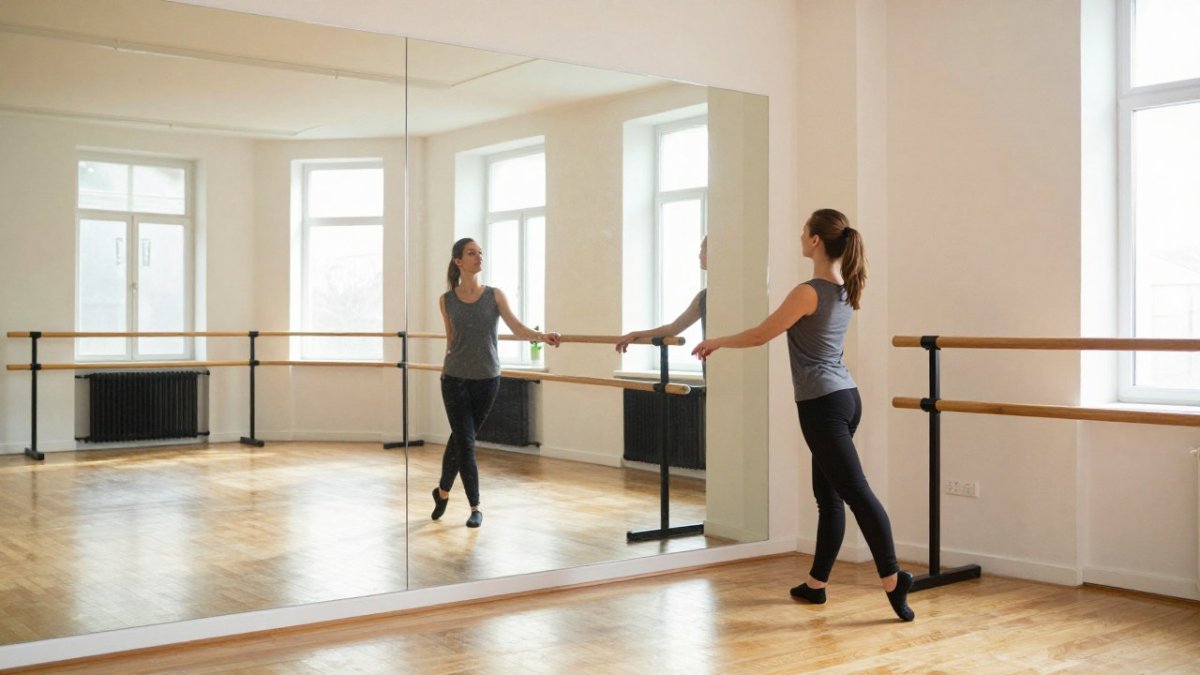
Position the mirrors so participants can see themselves and the instructor without turning their head too far. Avoid placing mirrors directly opposite windows, where glare can wash out the reflection.
For larger rooms,
Step 6: Consider Instructor Visibility, Accessibility and Lighting
Most mirror guides stop at "check the sightlines." In a group class, sightlines are a design problem with several variables: instructor position, participant height, seated and standing viewing, wheelchair access, and the way light behaves on glass. Getting these right is what separates a studio that works from one that merely looks finished.
Instructor visibility
Stand at the front of the room where you would normally teach, then check whether you can see every participant in the mirror, not just the front row. A common pattern is that the instructor's own reflection blocks the view of participants directly behind them. Adjust by offsetting the instructor's position slightly to one side of the mirror's centre line. Walk the room and test from the back corners, where sightlines are usually worst.
Accessibility and inclusive viewing
A mirror wall that works for a standing aerobics class may fail a seated yoga participant or a wheelchair user. Plan for a range of eye heights:
Ensure at least one full-height section of mirror is unobstructed by equipment, radiators or storage.
Keep the bottom edge low enough that seated participants can see their posture without craning.
Leave clear floor space in front of the mirrors so wheelchair users can position themselves at a useful angle rather than side-on.
Avoid placing mirrors behind fixed equipment that blocks approach.
Glare, lighting and acoustics
Glare is the most common complaint in mirrored studios, and it usually comes from windows or ceiling lights reflecting directly into participants' eyes. Test the room at the times of day you teach. If a window reflection washes out the glass, adjust blind or film placement rather than moving the mirrors. Harsh downlights create hot spots; diffused or indirect lighting gives a more even reflection. Large mirror walls also change how sound behaves in a room, reflections can make a studio feel louder and harder to hear instructions in. Soft furnishings, curtains and acoustic panels on non-mirrored walls help balance this.
Check sightlines from the front, back and corners of the room
Test glare at different times of day and with the lights you actually use
Confirm seated and wheelchair viewing before the mirrors are fixed
Keep the instructor's view of participants clear from every teaching position
Pro Tip Before committing to a fixed installation, mark the proposed mirror area on the wall with tape and run a class. Participants and instructors will quickly reveal blind spots, glare and access problems that are far cheaper to fix at the planning stage.
Booking a Mirror Assessment for Your Studio
Every studio is different. The right mirror choice depends on your room size, class types and how you plan to use the space. If you want help working through these steps,
Contact Mirrors for Training to talk through your requirements and get a quote.
Frequently Asked Questions
What type of glass is safest for gym mirrors?
Tempered or laminated safety glass is the usual choice for gym mirrors, because it breaks into small, blunt fragments rather than sharp shards. Safety backing, a protective film applied to the rear of the mirror, adds a further layer that holds fragments together if the glass is damaged. Look for a minimum glass thickness of 4 mm for general use, and ask the supplier to confirm that the product is tested for shatter resistance. Given the heavy movement in group classes, a thicker panel is worth considering for high-traffic halls.
Should gym mirrors be wall-mounted or portable?
The answer depends on whether you can fix mirrors permanently. Wall-mounted mirrors give a fixed, professional look, but they require drilling and may not be permitted if you rent the space. Portable mirrors on lockable wheels suit multi-use halls, where the room is used for dance in the morning, boot camps at lunch and youth sport in the afternoon. They can be moved aside when not needed and stacked for storage. Confirm that the wheels lock securely before every session, particularly where participants might lean on the mirror.
How do mirrors improve technique in group exercise classes?
Mirrors give participants visual feedback, so they can check their posture, alignment and movement timing without relying solely on the instructor's verbal cues. In large groups, instructors often cannot see every participant clearly, so mirrors allow people to self-correct during the session. Position mirrors so that participants can see themselves from the front or side, and make sure the instructor can also see the group. The aim is to support, not replace, instructor guidance.
Are portable mirrors effective for multi-use halls?
Portable mirrors can be effective in multi-use halls, provided they are stable, safely backed and easy to move. Because they do not need fixings, they suit venues that switch between dance, fitness and sport. Check the mirror's weight, the locking mechanism on the wheels and the storage footprint before you buy. Mirrors for Training offers pricing that depends on quantity, dates and delivery, so please contact the team on the website for a current quote tailored to your hall.

Comments