
The Best Mirror Shape for Dance Practice: A Buying Guide
Last Updated: November 17, 2026
Quick Summary
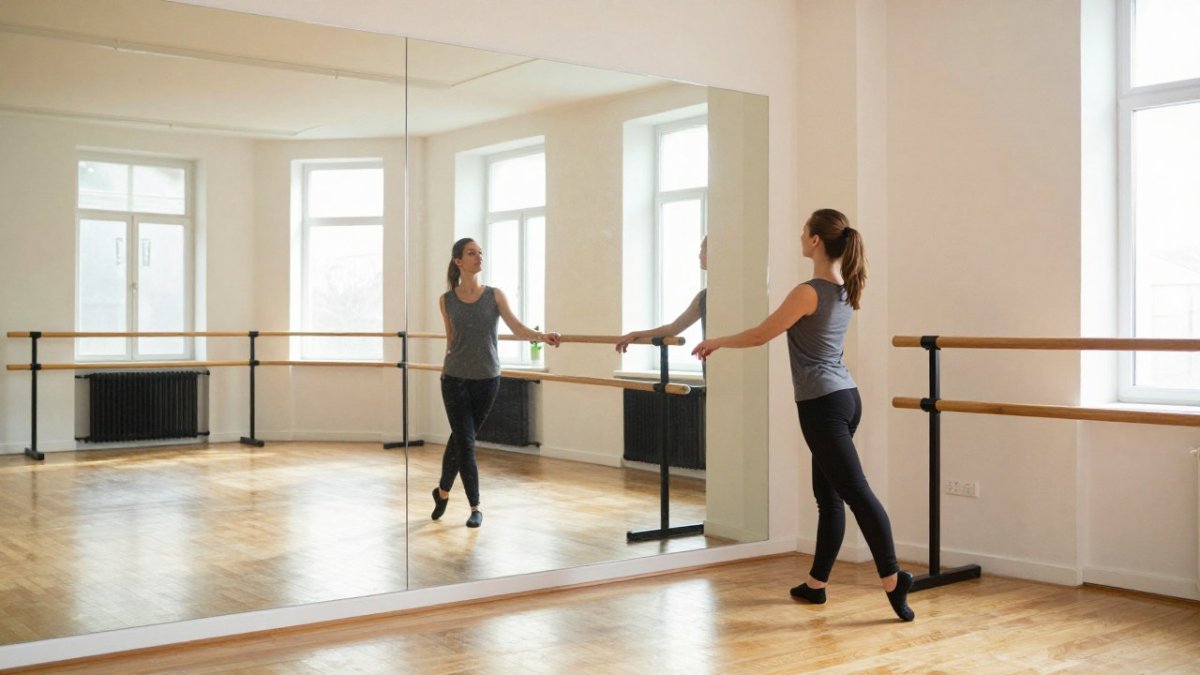
The best mirror shape for dance practice is a tall rectangle, because it keeps your whole body inside a consistent frame while preserving true verticals and horizontals. A rectangle shows you a flat, undistorted grid, so you can check level shoulders, square hips and straight footwork, while arches soften the top of the reflection and crop your arm lines.
A rectangle that reaches the floor keeps the whole chain from head to toe in one reflection.
Arches look better in a living space but crop the corners where arm lines and footwork live.
Add 15cm above your head for jumps and raised arms when sizing a mirror.
Confirm the bottom edge reaches within 10cm of the floor for footwork.
Set the mirror's centre at the eye level of the shortest regular user in shared spaces.
Which mirror shape suits your studio?
British-made portable mirrors on wheels, safety-backed and stackable, for studios that cannot drill.
Table of Contents
Why Mirror Shape Changes How You Practise
The best mirror shape for dance practice is a tall rectangle, because it keeps your whole body inside a consistent frame while preserving true verticals and horizontals. At Mirrors for Training, the shape question comes up often when we talk with studios, schools and clinics.
A rectangle shows you a flat, undistorted grid. You can see whether your shoulders sit level, whether your hips square up, and whether your footwork tracks in a straight line. An arch softens the top of the reflection and crops your arm lines.
That difference matters because mirrors feed proprioception, the sense of where your body sits in space. Research published in the International Journal of Social Science and Education Research examined how mirrors are used in dance teaching and found that the reflection shapes how dancers judge their own alignment.
How Shape Affects Body Lines and Footwork
Body lines read best against straight edges. A vertical edge acts as a plumb line, so you can spot a dropped elbow or a tilted pelvis without a teacher, and horizontal edges do the same job for level hips and square shoulders.
Footwork needs the bottom of the frame. If your mirror stops above ankle height, you cannot check a tendu, a lunge or a landing; a rectangle that reaches the floor keeps the whole chain from head to toe in one reflection.
Curved shapes are not useless. An arch suits a decorative home studio and looks softer in a spare room. It simply gives you less to measure against.
Rectangle, Arch or Square: Comparing the Main Shapes
Rectangles win for technique work because they preserve the vertical and horizontal references your eye needs. Arches look better in a living space but crop the corners where arm lines and footwork live. Squares only work at large sizes, and most domestic squares are too small for full-body viewing.
Here is how the three main shapes compare in practice:
Shape | Body Lines | Footwork Visibility | Best For |
Tall rectangle | Strong vertical and horizontal reference | Full, if it reaches the floor | Technique correction, ballet, contemporary |
Arched | Soft edges, weaker reference points | Cropped at the base | Decorative home studios, low-intensity practice |
Square | Neutral, no strong vertical guide | Depends entirely on size | Small spaces, upper-body work |
The tall rectangle is the shape we recommend for anyone serious about technique correction.
How Shape Geometry Interacts With Specific Dance Styles
Most guides treat shape as taste. In practice, the geometry of the frame changes what a dancer can check, and different disciplines lean on different reference points.
Ballet depends on true verticals and horizontals more than any other style.
Contemporary and release-based work rely on floor contact and spatial pathways.
Street and commercial styles often use wider, more horizontal shapes because the movement travels across the floor.
Tap and percussive styles need the bottom of the frame more than the top. If your mirror stops above ankle height, you cannot check a shuffle or a landing.
Arches have one honest advantage: they photograph well and suit a room that doubles as a living space.
Watch out: an arched mirror that leans against a wall tilts the reflection, and a tilted reflection distorts your sense of alignment.
Testing a Shape for Distortion Before You Commit
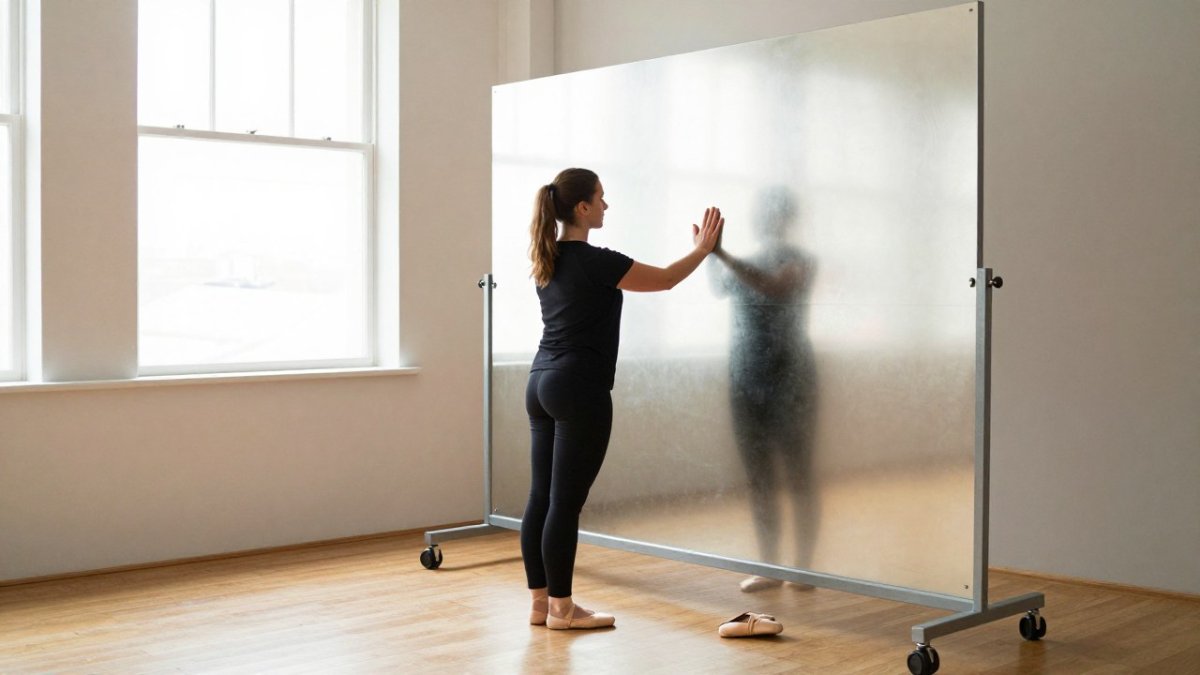
Shape is only half the decision. A badly made rectangle distorts more than a well-made arch, and most home mirrors are never tested for the 'funhouse' effect that makes technique work unreliable.
The practical test is a straight-edge check. Hold a metre rule or spirit level against the surface and look along it from the side: a true flat mirror keeps the reflection straight, a distorted one bows at the centre or edges.
A second test is the grid check. Tape a rectangular grid across the face and stand back; if the lines bow or converge, the surface is not flat enough for serious alignment work.
For dancers working at a professional level, the shape decision should be made after the distortion test, not before. A tall rectangle that passes the straight-edge check is worth more than a larger arch that fails it.
Dance Mirror Size and Height: Getting the Measurements Right
A dance mirror should be tall enough to show your full body from a comfortable working distance, and its width should allow you to extend your arms without leaving the frame.
The reliable way to size a mirror is to stand in front of the wall and measure. Use this checklist:
Stand barefoot and mark the top of your head on the wall
Mark the floor at your heels
Add 15cm above your head for jumps and raised arms
Measure your fingertip reach with arms in second position to set the width
Check the mirror's centre sits at roughly eye-level when mounted
Confirm the bottom edge reaches within 10cm of the floor
For dancers working on footwork, the bottom edge is the number most people get wrong. A mirror that starts 30cm off the floor hides exactly the part of the movement you need to see.
The Distance-to-Field-of-View Rule
The checklist gives a starting point, but the real constraint is geometry: what you can see depends on standing distance and reflective width. A mirror too narrow for your standing distance crops your arms even if it is tall enough.
The working rule is that the mirror width should be at least half your standing distance plus your arm span. If you practise two metres from the glass, a 90cm-wide mirror will feel tight when you extend into second position.
Height works the same way. A 1.8-metre mirror shows a full body from about a metre away, but step back to three metres to check a travelling sequence and the top and bottom start to crop. Dancers who work at distance often need a taller mirror or a pair set side by side.
Sizing for Children and Shared Spaces
Children need a lower centre point. In a school or a family home, a mirror mounted for adult eye-level leaves younger dancers looking up at their own reflection, which flattens the body lines they are trying to read.
The fix is to set the mirror's centre at the eye level of the shortest regular user, not the tallest. For a primary-age child that can mean a centre point around 1.1 to 1.2 metres from the floor, with the bottom edge reaching the floor so footwork stays visible.
In a shared studio the same logic applies across a class: size for the tallest and the shortest dancers lose the top of the frame; size for the shortest and the tallest lose the bottom.
Planning a Home Dance Practice Mirror Setup
Start with the wall, not the mirror. Measure the available height and width, check what the wall is made of, and decide whether you can fix anything to it permanently. Renters often cannot, and that single constraint changes the whole plan.

Safety matters in home setups. Look for a mirror with safety backing, especially in a room used by children.
If you want the full step-by-step version, our guide on how to set up a home dance practice mirror walks through measuring, mounting and lighting in order.
Portable Dance Mirror Options for Shared Spaces
Portable mirrors solve the problem fixed mirrors create in a multi-use venue. A mirror on lockable wheels rolls out for a session, locks in place, then stacks away when the room changes use, no permanent wall installation required.
Portable dance mirrors come in two broad types.
For a deeper comparison of the options, our portable mirrors for dance studios guide covers frames, castors and storage in detail. Dance schools weighing a portable set against a fixed mirror wall will find the trade-offs set out in our portable mirror wall comparison.
Where the need is temporary, hiring often beats buying. A show, an exam session or a short rehearsal block does not justify a purchase, and our mirror hire service covers exactly that case. For venues ready to commit, a set of four portable mirrors on wheels gives a full studio wall that folds away.
Dancing With a Mirror or Without a Mirror: Finding the Balance
Mirror work is a tool, not a rule.
The research backs the caution. A case study of eight dance students in beginner ballet classes examined how mirrors affected body image, and a 2026 discussion in Dance Magazine links heavy mirror reliance to negative body image and, in some cases, disordered eating habits.
The practical answer is a split. Use the mirror to check a shape, then turn away and repeat the movement on feel. That builds spatial awareness and stops you performing for the reflection rather than dancing the step.
A common mistake is treating the mirror as a constant judge. Dancers who check every repetition against the glass develop a habit of monitoring rather than sensing, and that habit follows them on stage where no mirror exists.
Choosing Your Dance Practice Mirror
Choose a tall rectangle first, size it to your full body with room for jumps, and decide between fixed and portable before you look at frames. That order saves money and returns.
On materials, acrylic and perspex faces resist impact and suit shared or child-heavy spaces. Glass gives the clearest reflection but needs safety backing and careful mounting.
For most multi-use venues, a portable mirror on lockable wheels is the practical pick: a professional mirrored environment without touching the walls, storing flat when the room changes purpose.
Plan the mirror size by counting how many dancers need to be in frame at once, then size the mirror to that number rather than to the wall.
The hardest part of choosing a dance mirror is not the shape. It is finding a solution that gives you a true reflection without locking you into a permanent installation.
Frequently Asked Questions
What is the best shape for a dance practice mirror?
A tall rectangle is the most practical mirror shape for dance practice. It keeps your full body within a consistent frame, shows vertical alignment clearly and leaves no wasted reflection above or below you. Arched mirrors look softer but curve the edges of the reflection, which makes it harder to judge straight body lines. Square tiles can work for small spaces but break the reflection into segments, so footwork and posture are harder to read as one continuous image.
How wide and tall should a dance practice mirror be?
For full-length visibility, the mirror needs to be tall enough to show you from the top of your head to your feet. Add width if you need horizontal coverage for choreography that travels, such as groups working side by side or exercises that move across the floor.
Are portable dance mirrors suitable for home practice?
Yes, particularly where wall fixing is not allowed or the room serves several purposes. Portable mirrors on lockable wheels can be stacked out of the way between sessions. Check that the unit has a safety backing, that the castors lock firmly and that the mirror stays vertical when in use. A leaning mirror tilts the reflection and distorts your perception of alignment, so a free-standing wheeled unit is the safer choice.
Is it better to practise dance with or without a mirror?
Both have a place. Mirrors give instant visual feedback for technique correction, helping with posture, body lines and footwork. A balanced approach works best: use the mirror to check specific shapes and alignment, then run the sequence without it so you build proprioception and spatial awareness rather than depending on the reflection.

Comments