
Why Portable Mirrors Suit Home Fitness Setups
Last Updated: November 19, 2026
Quick Summary
Portable mirrors suit home fitness setups because they roll to wherever you train and store out of the way afterward, unlike fixed wall glass. Lock the castors before a session, and choose safety-backed glass for any mirror you plan to move.
A rolling mirror turns a spare bedroom, garage or living room into a training zone on demand.
Full-length coverage means the mirror is at least as tall as you are, ideally a little taller.
Add 600 mm of clearance behind and beside the mirror for safe repositioning.
Safety backing keeps glass fragments attached if a panel cracks.
Lock every castor before a session starts to prevent most incidents.
Need mirrors that move with your workout?
British-made portable mirrors on wheels, safety-backed and lockable, built to your measurements.
Table of Contents
Why Home Gym Mirrors on Wheels Beat Fixed Installations
A home fitness setup rarely stays in one configuration: the bench moves for floor work, the mat comes out for Pilates, the bike gets pushed aside for a partner. Portable mirrors for home fitness setups solve that in a way wall-mounted glass cannot; the mirror moves to where the movement is, then back out of the way.
Mirrors for Training manufactures British-made rolling mirrors, and the pattern seen in professional studios repeats at home. A fixed mirror dictates where you train. A mobile one follows you.
What a Rolling Mirror Changes in a Shared Space
A rolling mirror turns a spare bedroom, garage or living room into a training zone on demand. Roll it to the wall for a strength session, lock the castors, and you have full-body visibility for squat depth and shoulder alignment.
That flexibility matters most in a multipurpose room. According to UK Active research on gym trends, the demand for adaptable home fitness equipment has grown as consumers seek to maximise limited square footage. A portable mirror panel can be repositioned between classes, sessions or households without touching the building fabric.
When a Wall-Mounted Mirror Still Makes Sense
Fixed glass wins in one scenario: a dedicated room that never changes use. If your gym has a permanent clear wall and nobody needs that floor space, a wall-mounted mirror is simple and stays put. The trade-off is commitment.
Renters often cannot drill at all, and for them a freestanding mirror or a mirror on wheels is the only realistic route to a professional training environment. We cover the construction differences in our guide to why fitness studios use safety-backed mirrors.
Choosing Home Gym Mirrors for Your Space and Workouts
The right home gym mirror depends on three things: what you train, how much floor you can spare, and whether the mirror must travel. Start with the workout, not the product page.

Strength training and functional fitness: you need full-length coverage from standing height down to floor level, so you can check hip hinge mechanics, knee tracking and bar path.
Yoga and Pilates: floor-level visibility matters more than height. A mirror that reaches the mat lets you check spinal alignment and weight distribution.
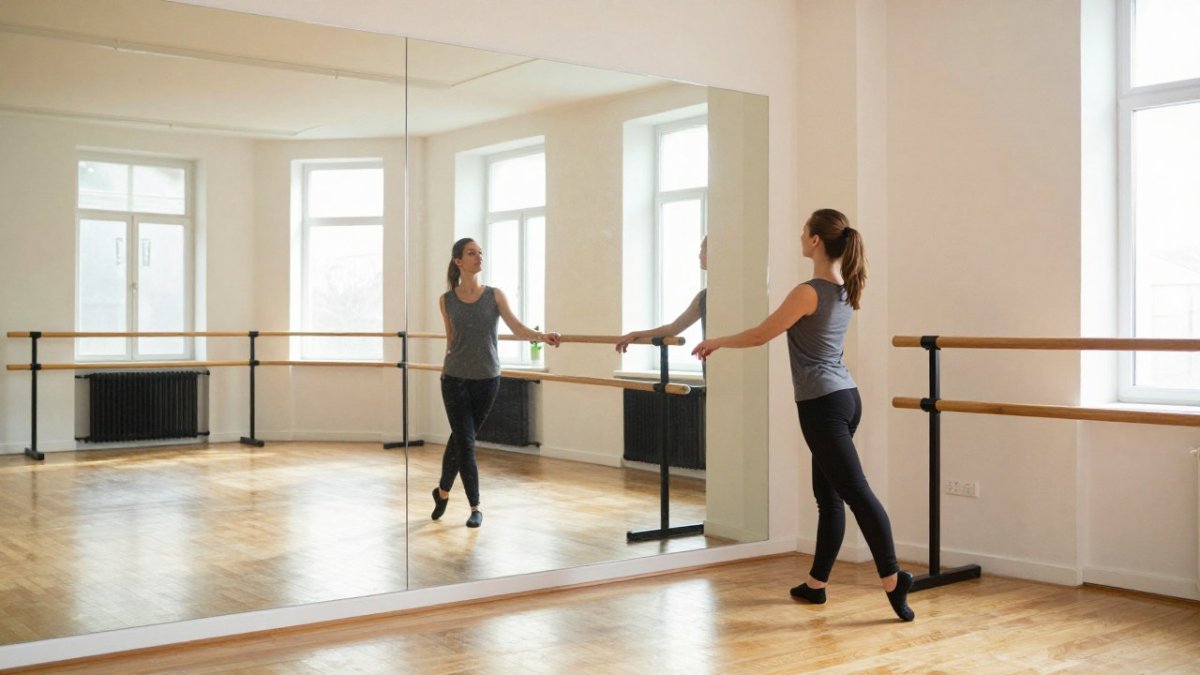
Dance training: width beats height. Multi-panel sets give the wide reflection dancers use to check line and spacing.
Sports training: a mobile mirror that can be angled toward a lifting platform or a drill station earns its keep.
Sizing Full-Length Mirrors for Exercise and Form Checking
Full-length coverage means the mirror is at least as tall as you are, ideally a little taller so you can see your whole body without crouching. Width is where home setups get it wrong: a single narrow panel cuts off your arms mid-extension, while two panels side by side give you the width to check a squat stance or a dance line. In a large garage or converted studio, a supersized option such as our extra large portable mirror shows how much coverage is possible.
Work Out Your Viewing Distance Before You Choose a Height
The height figure only works if you stand at the right distance. A useful rule of thumb: the mirror should be tall enough that your full reflection fits when you stand roughly 1.5 to 2 times your own height away from the glass. If your training footprint is tight, such as a spare bedroom where the mat sits only 1.2 m from the wall, you need a taller panel, not a wider one.
Place the Mirror to See Form, Not to Fill a Wall
Where the mirror sits changes what you can check. For squat and deadlift work, a mirror directly in front of the platform shows knee tracking and hip hinge; at 45 degrees it shows bar path and shoulder alignment but distorts depth perception. Avoid placing the mirror so it reflects a doorway, television or bright window behind you, as the reflection competes with your own image.
Measure the Room in Ten Minutes
Measure twice, buy once. This sequence prevents the most common return reason.
Mark your training footprint with tape on the floor: length and width of the mat or platform.
Measure the clear wall or floor space where the mirror will stand when in use, and note the distance from your feet to the glass.
Add 600 mm of clearance behind and beside the mirror for safe repositioning.
Measure the doorway and any corridor the mirror must roll through, including threshold strip height.
Measure your storage spot: stacked mirrors need depth as well as width.
Check ceiling height against the mirror's height plus wheel clearance.
Watch out: a mirror that fits the wall but not the doorway is the single most common measuring mistake; check the narrowest point on the route before you order.
Glass, Frames and Safety Backing Explained
Safety backing is the single most important specification on a mirror you plan to move: a film bonded to the rear of the glass so that, if the panel cracks, fragments stay attached instead of falling free. This is a critical safety consideration for home environments, especially where children or pets are present.
Tempered glass is stronger than standard mirror glass and breaks into small blunt pieces rather than sharp shards. Framing and edge finish affect durability as much as looks. Polished edges reduce chips during handling, and a framed edge protects the panel when stacked or rolled against a wall.
Portable Mirror Safety and Stability in Busy Training Spaces
Stability comes down to three things: wheel locks, base width and weight distribution. A portable mirror is only as safe as its castors. Lockable wheels hold the frame in place during a session, and a wide base resists tipping when someone leans or loses balance.
Wheel Locks, Base Width and Tip-Over Prevention
Lock every castor before a session starts. That single habit prevents most incidents. Beyond that, position the mirror against a wall where possible, keep the heaviest part of the frame at the base, and never let participants use the mirror as a support or balance aid.
Multi-use facilities move equipment constantly, so it is sensible to check castors and locks regularly for wear. Our article on how mobile training mirrors improve performance covers how stable, well-positioned mirrors support technique work.
Lighting, Glare and Reflection Quality
Reflection quality depends on what the mirror faces, not just the glass. Place it opposite a window and you will squint into glare every session; place it on a side wall, angled across the room, and the light falls on you rather than into your eyes. Control what the mirror sees rather than buying a different mirror.
Position the Mirror Relative to Your Light Source
Aim for light falling on you from the side or above, with the mirror facing a plain, mid-tone wall. If your only window is on the wall you want to face, angle the mirror across the room rather than square-on. For strength work, a mirror facing a wall lit by a diffused floor lamp aimed at the ceiling gives even illumination without a hotspot.
Reduce Glare Without Blacking Out the Room
Direct sunlight on the glass is the worst case: it washes out the reflection and makes form checking harder. A sheer blind or net curtain on the window the mirror faces cuts the hotspot without plunging the room into gloom. Avoid reflecting a television, phone screen or bare downlight, as each becomes a bright patch that pulls your eye away from your form.
Keep the Glass Clean Enough to Read
Fingerprints and dust scatter light and blur the image. A microfibre cloth and a pH-neutral glass cleaner keep the surface clear; ammonia-based sprays can cloud the backing over time. According to British Glass manufacturing guidelines, using non-abrasive cleaners is essential to maintaining the longevity of silvered glass surfaces.
Watch out: a mirror that faces a window may look fine at midday and become unusable at dusk when the room light overtakes the daylight; test the placement at the time of day you actually train.
Moving, Storing and Maintaining Your Portable Mirrors
Portable mirrors last when you move them the way they were designed to move. Roll, do not drag. Two people for anything taller than shoulder height. Lock the castors before loading or unloading a stack. Our guide on how to clean gym mirrors without streaks sets out the method step by step.
Task | Frequency | Time Needed |
Wipe mirror glass | After each session | 2 minutes |
Check wheel locks and castors | Weekly | 5 minutes |
Clean frame and edges | Monthly | 10 minutes |
Inspect safety backing and fixings | Quarterly | 15 minutes |
Specify Your Portable Mirrors With a Made-to-Measure Quote
Off-the-shelf sizes fit some rooms and fight the rest. Mirrors for Training manufactures British-made mirrors with safety-backed glass, lockable wheels and a stackable design. To see what a rolling set looks like in practice, our set of 4 portable mirrors on wheels is the configuration most home and studio buyers start with.
Your training space does not have to be permanent to be professional.
Frequently Asked Questions
Are portable mirrors stable enough for exercise?
A well-built portable mirror is stable when its wheels are locked and the base is wide enough to resist a sideways push. Portable mirror safety and stability come down to three things: lockable castors on every wheel, a weighted or broad base, and safety-backed glass that holds together if struck. Check that the frame does not flex when you lean on it, and lock the wheels before every session. Models designed for training, rather than decorative mirrors on castors, are built to take repeated repositioning in busy spaces.
How large should a mirror be for a home fitness setup?
You need full-body visibility from your working position, not from the doorway. For most strength training, yoga and Pilates, a full-length mirror lets you see head to feet while standing a metre or two back. If you train on the floor, check the mirror reaches low enough to show your hips and legs during mat work. Measure the wall or floor space first, then confirm the mirror's footprint including its wheels and base, so it still fits when angled for viewing.
Can portable gym mirrors be stored away between sessions?
Yes, and that is the main reason facilities choose them. Rolling mirrors move to a storage area or stack together when the room reverts to another use. Before buying, measure your storage bay and check the stacked depth of the frames, plus the turning circle needed to wheel them through doorways and around corners. A stackable design with lockable wheels makes the mirror practical for multipurpose rooms, rented studios and homes where the training area doubles as a living space.
Is a portable mirror better than a wall-mounted gym mirror?
It depends on whether you own the space and how often the room changes use. A wall-mounted mirror gives a seamless, permanent finish and never needs moving, but it requires drilling and landlord permission. Portable mirrors on wheels suit rented studios, multipurpose halls and home gyms that share a room with other activities, because they reposition in seconds and store out of the way. Many facilities use both: fixed mirrors on one wall and a rolling mirror for the open floor.

Comments